I’m stuck in this strange limbo of being excited to go home and see family and friends I’ve been missing, and not wanting to leave this new life I’ve built here and people I’ve met. To illustrate this inner-conflict, I made me some fancy lists I thought I would share with you:
Things I will miss:
- MY FAMILY (even though Ma can be over-controlling, and hoards things in her room like a packrat, she means well, and I will miss her.)
- Having funny/interesting interactions with funny/interesting people in the most unexpected places and times
- Senegalese fruit and juice (Buiy, Ditakh, Bissap, Guava)
- French bread
- Senegalese prices (breakfast for fifty cents!)
- Attaaya (concentrated and very sweet green tea)
- Eating out of a communal dish
o When I have to resort to using my hand to eat because I can’t
quite get all the food on my spoon into my mouth, it looks like
I’m just more Senegalese, not more of a slob.
- Colorful and bright traditional Senegalese clothing
- Having 60 degrees Fahrenheit be the coldest part of my day
- Nearly constant sunshine
- Affordable public transportation
- Having an excuse to never do my hair or make-up (blow dryers waste electricity, and it is usually so hot that it would melt away immediately anyway)
- Cheap liquor
- Cathartic sassiness (here, when I stand up for myself, I generally get a desirable result- LEFT ALONE. In the states, the result might be less desirable, such as SHANKING)
- Two hour lunch breaks
- The call to prayer
- Having a get out of jail free card for doing awkward things just because I’m a toubab, and toubabs do awkward things
- Talking about whatever I want, whenever I want, because most people don’t understand English
- Cooking with Shani and Giulia
- Beautiful, cheap henna
- Cracking up in Ellen’s room for no real reason
- Seeing Ellen’s face errryday
Things I will not miss:
- Being harassed by Senegalese men
- Cold showers
- Being poked by the springs sticking out of my mattress
- Having unidentifiable sheep organs as a regular part of my diet (including, but not limited to the head, feet, testicles, liver, intestines, and stomach)
- Senegalese Cous Cous
- Suppakanja
- Finding an acceptable excuse to justify every time I want to go out of the house
- Needing to bring a flashlight with me into the bathroom
- Wet toilet seats from the showerhead that sits almost directly over the toilet
- Cockroaches
- Mangy cats and dogs dying or fighting in streets
- Bad hangovers from cheap liquor (ellen wants me to take this off the list, because going to the states will change nothing)
- Different forms of carb counting as different food groups (e.g. fries on spaghetti eaten with bread)
- Trash in the streets
- Sewage water in the streets
- The smell that comes with the two previously listed items
- The only forms of dairy being laughing cow cheese, ice cream, and powdered milk
- Navigating via landmarks and vague gestures instead of maps or street names
- Awkward conversations with acquaintances, explaining why I do not have a fiancé or husband, nor do I have any interest in finding one in the near future
- Pulling bones out of my mouth as a part of every meal
- Flies
- Having strangers demand that I speak Wolof, and then get very frustrated when my level of Wolof is about the equivalent of a mocking bird that uses the same handful of phrases at random no matter what someone says to it
Friday, February 3, 2012


Wednesday, February 1, 2012
Good Morning Dakar: Talibe and Funerals
It's in my daily activities and interactions that you can really get an idea of what it's like to live in Dakar. This morning has not been anything special, but it involved interactions with both death and Talibe, which are sad but constant facets of life here.
Talibe are the children who supposedly attend Quranic school, and live there under the care of a marabout. This marabout supervises their education, which consists of memorizing the entirety of the Quran in arabic (resulting in an ability to recite the Quran, but no comprehension). For each meal, all of the children are sent out into the streets to beg for food and/or money. On principal, I refuse to give the children money- it is given directly to the marabout, and I'm not about to support adults using children to beg for money. However, if I have food handy, I have no problem giving that away.
Every morning, the Talibe knock on our family's door asking for food, and reliably Ma will send one of the maids or one of the girls to go to the door and hand out sugar cubes. Usually, when I poke my head out to see what's going on, I see Moune laying sugar cubes in their food tins that are already filled with sugar cubes. I guess it's the cheapest food ingredient that families prefer to give away.
I don't understand why they even bother giving to them everyday if they're just throwing more sugar at them. That does not make a breakfast. That makes diabetes. So, today, I left the house for school when the talibe came, and I hid around the corner so Moune wouldn't see me giving away my breakfast (a small loaf of bread) to the kids. Really, Ma? This bread costs about 50 cents for a baguette about three feet long, and the kids can ACTUALLY eat it.
So I gave away the breakfast my host family gave me, and bought breakfast number two at the boutique across the street. My new favorite is bread with laughing cow cheese and tuna spread (whopping 50 cents total). When I was talking with fruit man, he told me he attended the funeral yesterday of the guy who used to sell coal across from my house. I didn't know the guy at all, but apparently he was very polite and everyone liked him. He felt sick for two days, and then he went to sleep and didn't wake up on the third night. It's widely accepted by the community that he got sick from handling coal without any sort of physical protection every day.
Sudden deaths are terrifyingly common here. More than once, I've come downstairs for breakfast to hear Ma tell me, "Dafa, my sister's father is very sick, and he might die. I'm going to go visit them in Rufisque, for the day, I'll be back later." or, "Awe won't be doing laundry this week because her mother just died and she needed to go to the funeral out of town." or like just yesterday, when I was talking with Momo, my host brother. I was asking about his siblings, and he told me he has one older brother who is still alive, but had two older sisters who died when they were 27 and 30 years old. People deal with a lot of premature or sudden death and loss on a much too frequent basis here.
I am grateful that I haven't experienced many similarly tragic events in my own life, and am always at a loss for words when I am confronted by them here.
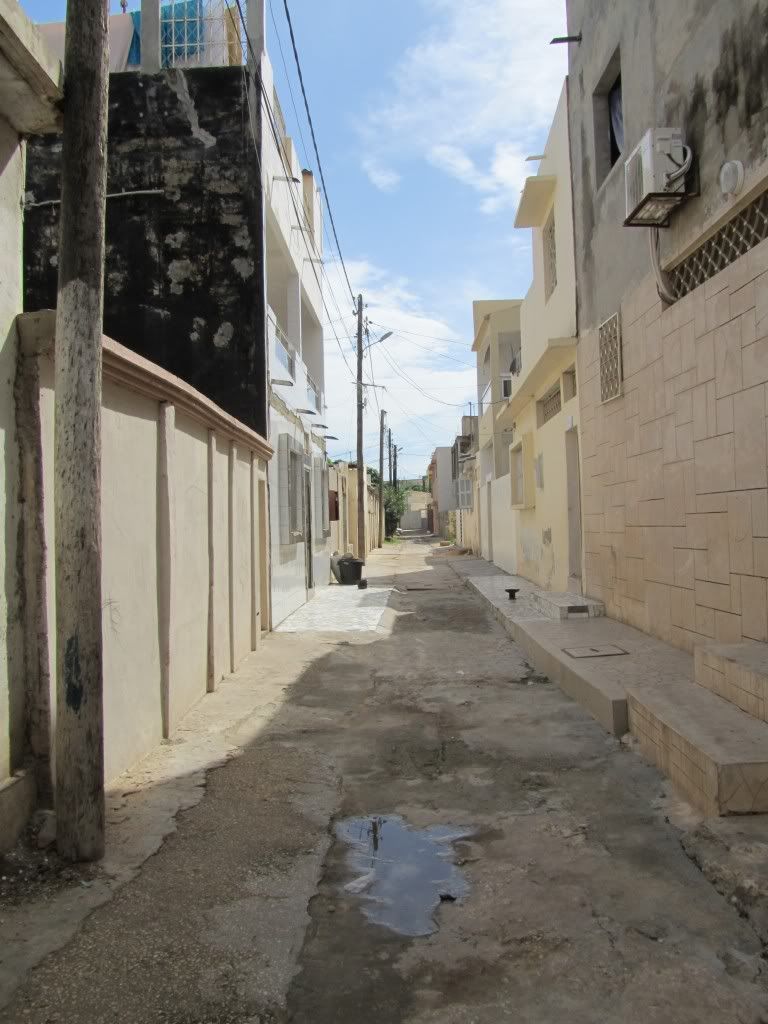
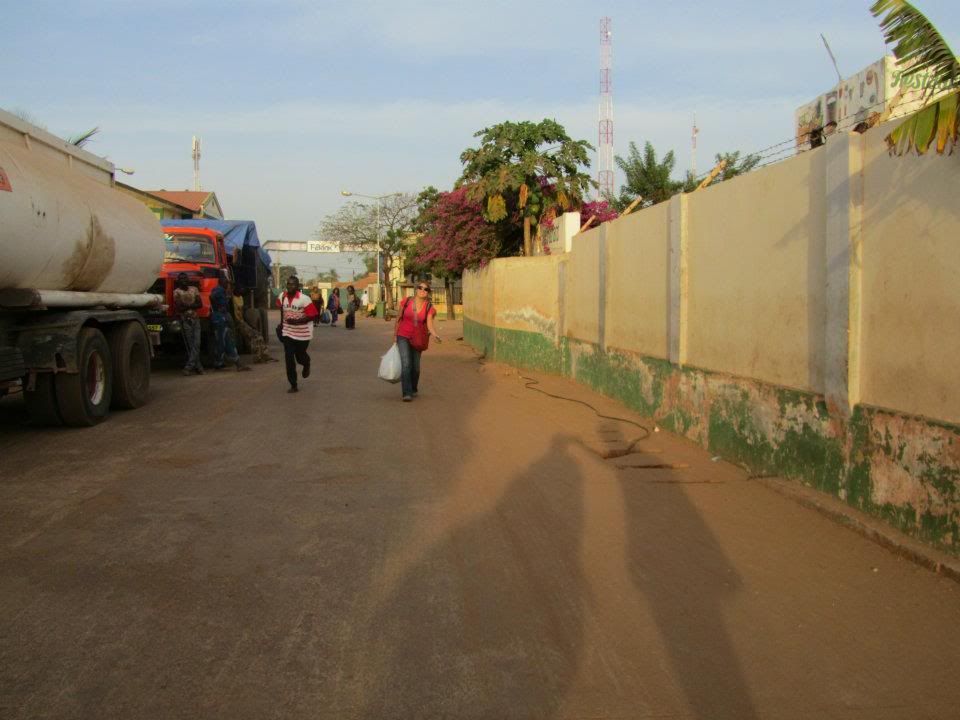
 This is the street I live on. The left is the front of my house.
Talibe are the children who supposedly attend Quranic school, and live there under the care of a marabout. This marabout supervises their education, which consists of memorizing the entirety of the Quran in arabic (resulting in an ability to recite the Quran, but no comprehension). For each meal, all of the children are sent out into the streets to beg for food and/or money. On principal, I refuse to give the children money- it is given directly to the marabout, and I'm not about to support adults using children to beg for money. However, if I have food handy, I have no problem giving that away.
Every morning, the Talibe knock on our family's door asking for food, and reliably Ma will send one of the maids or one of the girls to go to the door and hand out sugar cubes. Usually, when I poke my head out to see what's going on, I see Moune laying sugar cubes in their food tins that are already filled with sugar cubes. I guess it's the cheapest food ingredient that families prefer to give away.
I don't understand why they even bother giving to them everyday if they're just throwing more sugar at them. That does not make a breakfast. That makes diabetes. So, today, I left the house for school when the talibe came, and I hid around the corner so Moune wouldn't see me giving away my breakfast (a small loaf of bread) to the kids. Really, Ma? This bread costs about 50 cents for a baguette about three feet long, and the kids can ACTUALLY eat it.
So I gave away the breakfast my host family gave me, and bought breakfast number two at the boutique across the street. My new favorite is bread with laughing cow cheese and tuna spread (whopping 50 cents total). When I was talking with fruit man, he told me he attended the funeral yesterday of the guy who used to sell coal across from my house. I didn't know the guy at all, but apparently he was very polite and everyone liked him. He felt sick for two days, and then he went to sleep and didn't wake up on the third night. It's widely accepted by the community that he got sick from handling coal without any sort of physical protection every day.
Sudden deaths are terrifyingly common here. More than once, I've come downstairs for breakfast to hear Ma tell me, "Dafa, my sister's father is very sick, and he might die. I'm going to go visit them in Rufisque, for the day, I'll be back later." or, "Awe won't be doing laundry this week because her mother just died and she needed to go to the funeral out of town." or like just yesterday, when I was talking with Momo, my host brother. I was asking about his siblings, and he told me he has one older brother who is still alive, but had two older sisters who died when they were 27 and 30 years old. People deal with a lot of premature or sudden death and loss on a much too frequent basis here.
I am grateful that I haven't experienced many similarly tragic events in my own life, and am always at a loss for words when I am confronted by them here.
Tuesday, January 17, 2012
Getting to Gambia
The previous entry was a very basic explanation of travel within the city, which Ellen, Lauren, and I had more or less mastered learned to stumble through when we left on a week-long trip to Gambia. Turns out more long-distance travel is basically organized the same, except it's a little more expensive and time-consuming if when you mess up.
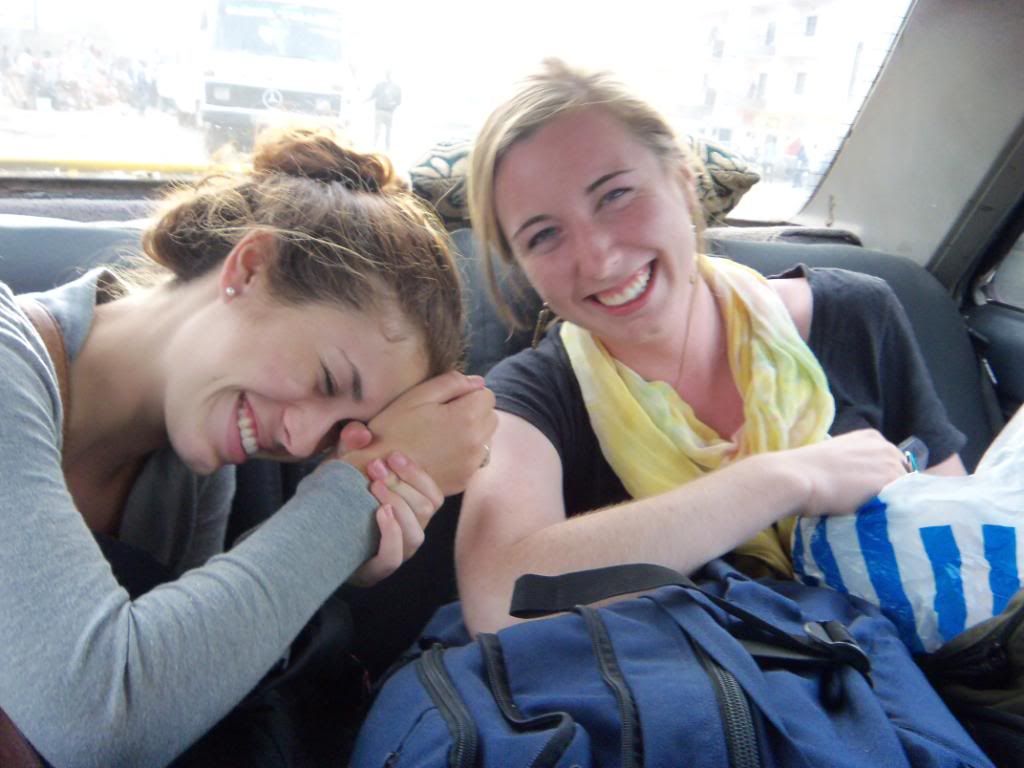
The day before we left for our week-long trip to Gambia, we still had virtually no plans, aside from the visas we had already gotten and directions from a staff-member at the Baobab Center to take a specific bus at 8am to take us directly to Gambia the next day. Well, the next day we hailed a taxi and explained the garage we needed him to take us to (all we had was the name of the place, of course he didn't speak French, and he didn't know where it was, so he pulled over a few times to ask directions). We made it to the garage with plenty of time to spare, but a kind gentlemen informed us upon arrival that our bus wasn't supposed to leave until 8 PM that night. Thus, one-half of the preparations we made for this trip were already null and void before we even left the city. What then followed was an hour of our angel of a driver taking us to various other garages and inquiring about transport to Gambia, including about 15 minutes of what appeared to be him standing, waiting for another bus on the other side of a 4 lane highway. I say "appeared to" because we didn't understand a single thing that man said to us, and really had no idea what was happening. Meanwhile, we were waiting in the car, trying (unsuccessfully) not to burst into hysterics (pictured below).

Still haven't left Dakar, and it was then 10am. A bus finally drove up, our driver bargained the collective ticket price of 4,500CFA (about $3 each), and helped us get on board. We said goodbye to our driver, thanked him profusely, and gave him a snickers bar and what I hope was a generous tip.

Once we got settled in the bus, we breathed a collective sigh of relief: Finally, on our way to Gambia! Sometime shortly after that feeling of relief, we noticed the entire bus was crawling with mosquitoes. I spent the rest of the ride dozing in and out of sleep, shooing mosquitoes away from my head, and sweating. It was getting to be the hottest time of day, and the bus was stopping way too often for the breeze from the windows to do much good. We were on that damn bus for just about 4 hours. And it didn't even take us all the way to Gambia; only about two thirds of the way. Once we got off, we used a bathroom at the gas station, bought some cold drinks, and met a couple gas attendants who claimed us as their girlfriends. The town is called Kaolack, and is a bustling travel hub for Senegal. When we were ready to start the next leg of the trip, we left the gas station and were immediately swarmed by six or seven men fighting with each other to see who would get to be our escort to the appropriate transport.
**This is how Senegalese "garages" operate: they're large sandlots pack-jammed with vans, buses, and sept-places (station wagons) loosely organized by travel destination. When you arrive, you're rushed by men who know their way around, asking where you want to go. One of them takes you where you need to be (I suspect he also earns a small tip from that driver for bringing him passengers).
After a bit of scrambling, Wolof arguing, and being lead in circles, we found a large van headed to the border. That ride took another 2 hours, but the other passengers were very friendly. We were all dropped off at the border, where our names, passport numbers, and occupations were very officially recorded in blue ballpoint pen in a giant notebook. Next step: exchange Senegalese CFA for the Gambian currency, Dallasi. Gambia was colonised by the British, so English is their national language. Dallasi is their pigeon-english version of Dollars. About 30 Dallasi equals 500 CFA, or $1.

On the other side of the border, we directly boarded another bus for 21 Dallasi and arrived in the capital city of Banjul in a mere 45 minutes. There, we followed our new travel companions (a group of older Gambian women headed by Mami, who passionately fought for my honor at the border when a woman giving me Dallasi for CFA tried ripping me off) to the ferry to cross the bay to Bakau, where we decided we would be spending our first night.
Mami knew it was the last ferry of the day, so she was rushing everyone to move quicker. I bought tickets for everyone, and we started across the bridge. We all stopped, however, when someone pointed out the bags and the old woman (who turned out to be her mother) Mami left at the gate. Knowing we were running late, Ellen and I didn't bother to ask questions before grabbing the two large, lumpy garbage bags. Mami kept yelling at us, "Run!", which was a bit funny, since we were all weighed down by heavy luggage, and the older women weren't really capable of going much faster than what was a brisk walk for us young'uns.

Luckily, we all made it onto the ferry, but it was only a few minutes once we were on before it pulled away from the dock. The ride was supposed to take 45 minutes, but we had a little detour. The other ferry's engine had either broken down or run out of gas, and we had to tow it to the other side of the bay with us. It was two hours later, and about 9:30pm when we were finally able to de-board (Ellen and I were still carrying Mami's bags). Furthermore, it wasn't until now that we tried calling the hotel and realized our Senegalese phones didn't work.
Mami saved us again by letting us use her phone to call, and she bargained the price of a taxi to take us there. At this point, we had been travelling upwards of 13 hours, and were quickly losing mental functionality. I was incredibly grateful for Mami's kindness and generosity. Oh yeah, and did I mention that the entire trip to Gambia was only supposed to take 4-5 hours total?

Basically, we were completely dependent on the good will and ability of others to show us where to go and what to do. Aside from the time I accidentally got in a bus headed for Ziguinchor (a region of Senegal south of Gambia), the good will of local people generally lead us in the correct direction.
The day before we left for our week-long trip to Gambia, we still had virtually no plans, aside from the visas we had already gotten and directions from a staff-member at the Baobab Center to take a specific bus at 8am to take us directly to Gambia the next day. Well, the next day we hailed a taxi and explained the garage we needed him to take us to (all we had was the name of the place, of course he didn't speak French, and he didn't know where it was, so he pulled over a few times to ask directions). We made it to the garage with plenty of time to spare, but a kind gentlemen informed us upon arrival that our bus wasn't supposed to leave until 8 PM that night. Thus, one-half of the preparations we made for this trip were already null and void before we even left the city. What then followed was an hour of our angel of a driver taking us to various other garages and inquiring about transport to Gambia, including about 15 minutes of what appeared to be him standing, waiting for another bus on the other side of a 4 lane highway. I say "appeared to" because we didn't understand a single thing that man said to us, and really had no idea what was happening. Meanwhile, we were waiting in the car, trying (unsuccessfully) not to burst into hysterics (pictured below).
Still haven't left Dakar, and it was then 10am. A bus finally drove up, our driver bargained the collective ticket price of 4,500CFA (about $3 each), and helped us get on board. We said goodbye to our driver, thanked him profusely, and gave him a snickers bar and what I hope was a generous tip.
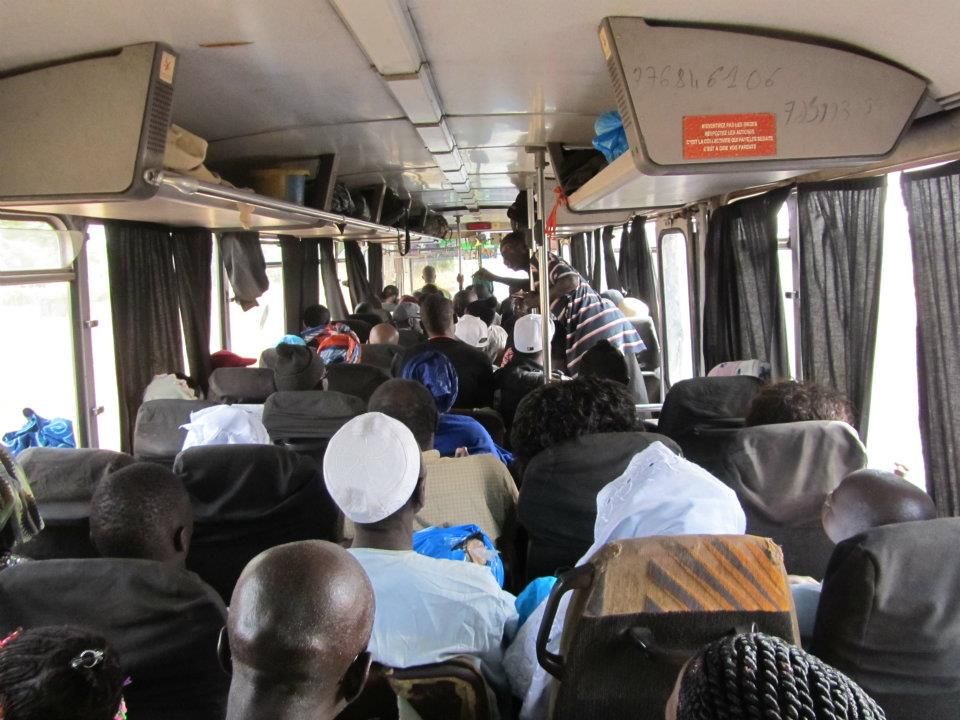
Once we got settled in the bus, we breathed a collective sigh of relief: Finally, on our way to Gambia! Sometime shortly after that feeling of relief, we noticed the entire bus was crawling with mosquitoes. I spent the rest of the ride dozing in and out of sleep, shooing mosquitoes away from my head, and sweating. It was getting to be the hottest time of day, and the bus was stopping way too often for the breeze from the windows to do much good. We were on that damn bus for just about 4 hours. And it didn't even take us all the way to Gambia; only about two thirds of the way. Once we got off, we used a bathroom at the gas station, bought some cold drinks, and met a couple gas attendants who claimed us as their girlfriends. The town is called Kaolack, and is a bustling travel hub for Senegal. When we were ready to start the next leg of the trip, we left the gas station and were immediately swarmed by six or seven men fighting with each other to see who would get to be our escort to the appropriate transport.
**This is how Senegalese "garages" operate: they're large sandlots pack-jammed with vans, buses, and sept-places (station wagons) loosely organized by travel destination. When you arrive, you're rushed by men who know their way around, asking where you want to go. One of them takes you where you need to be (I suspect he also earns a small tip from that driver for bringing him passengers).
After a bit of scrambling, Wolof arguing, and being lead in circles, we found a large van headed to the border. That ride took another 2 hours, but the other passengers were very friendly. We were all dropped off at the border, where our names, passport numbers, and occupations were very officially recorded in blue ballpoint pen in a giant notebook. Next step: exchange Senegalese CFA for the Gambian currency, Dallasi. Gambia was colonised by the British, so English is their national language. Dallasi is their pigeon-english version of Dollars. About 30 Dallasi equals 500 CFA, or $1.
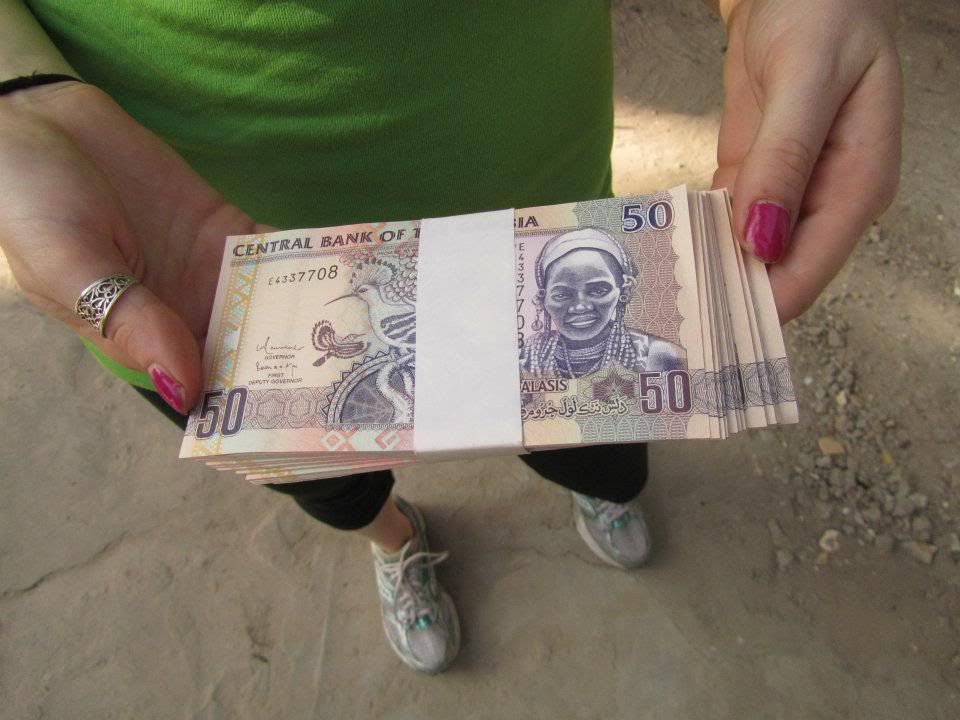
On the other side of the border, we directly boarded another bus for 21 Dallasi and arrived in the capital city of Banjul in a mere 45 minutes. There, we followed our new travel companions (a group of older Gambian women headed by Mami, who passionately fought for my honor at the border when a woman giving me Dallasi for CFA tried ripping me off) to the ferry to cross the bay to Bakau, where we decided we would be spending our first night.
Mami knew it was the last ferry of the day, so she was rushing everyone to move quicker. I bought tickets for everyone, and we started across the bridge. We all stopped, however, when someone pointed out the bags and the old woman (who turned out to be her mother) Mami left at the gate. Knowing we were running late, Ellen and I didn't bother to ask questions before grabbing the two large, lumpy garbage bags. Mami kept yelling at us, "Run!", which was a bit funny, since we were all weighed down by heavy luggage, and the older women weren't really capable of going much faster than what was a brisk walk for us young'uns.
Luckily, we all made it onto the ferry, but it was only a few minutes once we were on before it pulled away from the dock. The ride was supposed to take 45 minutes, but we had a little detour. The other ferry's engine had either broken down or run out of gas, and we had to tow it to the other side of the bay with us. It was two hours later, and about 9:30pm when we were finally able to de-board (Ellen and I were still carrying Mami's bags). Furthermore, it wasn't until now that we tried calling the hotel and realized our Senegalese phones didn't work.
Mami saved us again by letting us use her phone to call, and she bargained the price of a taxi to take us there. At this point, we had been travelling upwards of 13 hours, and were quickly losing mental functionality. I was incredibly grateful for Mami's kindness and generosity. Oh yeah, and did I mention that the entire trip to Gambia was only supposed to take 4-5 hours total?
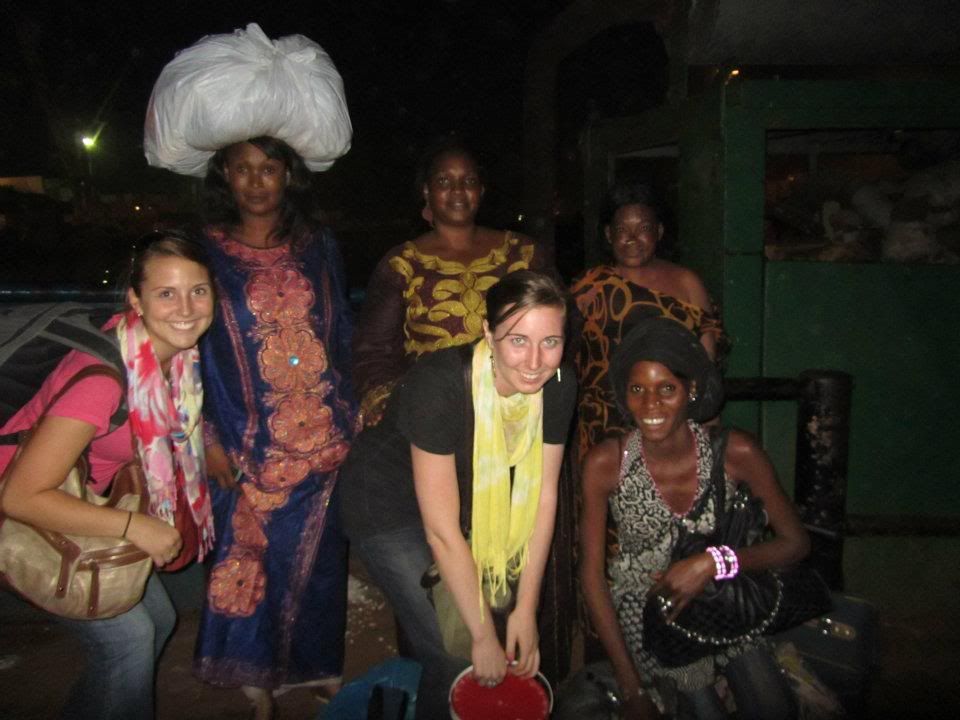
Basically, we were completely dependent on the good will and ability of others to show us where to go and what to do. Aside from the time I accidentally got in a bus headed for Ziguinchor (a region of Senegal south of Gambia), the good will of local people generally lead us in the correct direction.
Thursday, January 12, 2012
Travel in Dakar: Car Rapides, Taxis, and Buses, Oh my!**
Something I've been meaning to do a blog entry on is the topic of travel in Senegal. My story of accidentally visiting Keur Massar (the crowded, very un-touristy and dusty town located on the edge of Dakar) instead of Keur Moussa (the very tourist-friendly monastery that sells a delightful variety of Senegalese fruit-flavored alcoholic beverages and jams located just outside of Dakar) illustrates the constant occurrence of unexpected travel hiccups, especially for travellers who aren't familiar with the way public transport is organized here.
When I use public transport, I'm used to going online to find a bus, metro, or train schedule, and then using a map to find my way to the appropriate station. Before coming to Senegal, I considered myself quite self-sufficient when it comes to maneuvering public transport. Nothing I learned from the various trips I've taken around the states and a couple in Europe, or in my home state of Michigan (which is a joke, since public transport barely even exists there), however, even came close to preparing me for Senegalese travel.
Getting around Dakar is cheap enough: in general, you can take a taxi just about anywhere in the city with $4.50 being the most expensive ride. And that rate stays the same whether you're alone or sharing that taxi with three other people. Finding a taxi is also (almost) never an issue. I think one of my professors told me that Dakar is a city with one of the highest taxi to privately owned car ratios in the world. I'm too lazy to see if that's accurate, so don't quote me on that, but believe me, there are taxis EVERYWHERE. The challenge lies in bargaining for that reasonable price, and then communicating to the driver your desired destination. Some drivers speak French fluently and are easier for me to communicate with, and others only speak Wolof. If I'm headed someplace I've been before, or a destination that's well known by the locals, I just say the name of the place, and the ride generally goes smoothly. It's when we try things like finding a new restaurant that our friend, Mr. Lonely Planet, recommends and gives us directions to using radical things like street names and maps that we run into real issues. Locals generally describe locations using landmarks, whereas street names change, are unmarked, or are simply unknown to the local population.
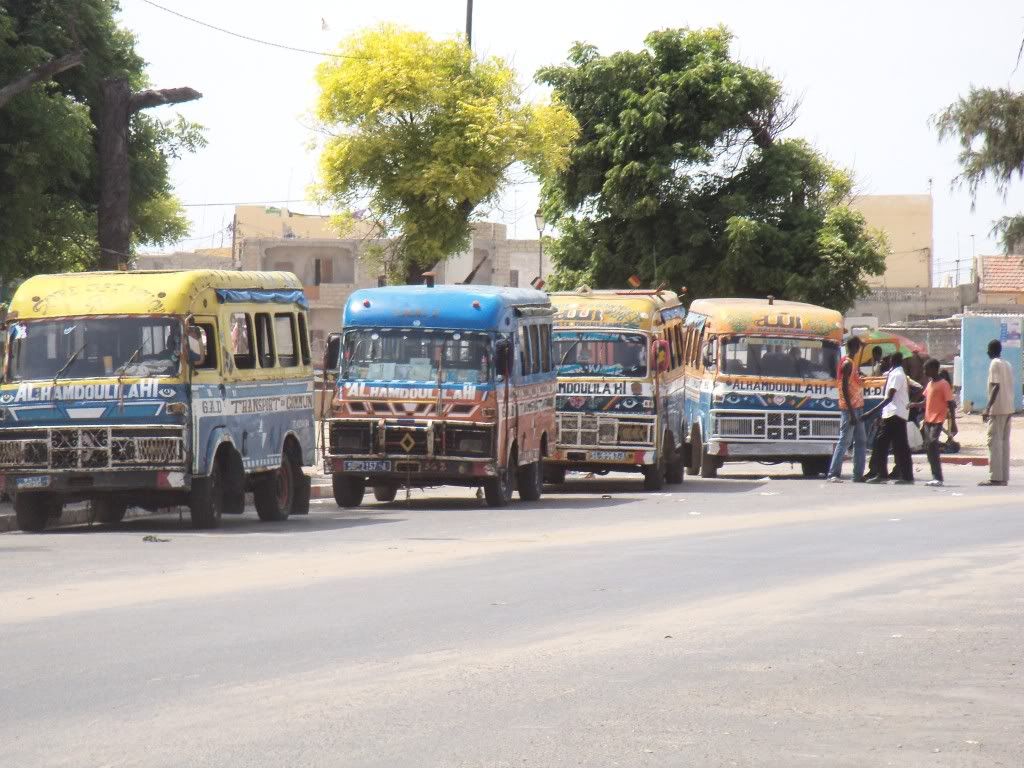
We quickly learned that asking for directions was the only way to navigate this city. Once we mastered the art of bargaining fair prices for taxi rides and knowing where we were going, we began taking cheaper forms of public transportation. This means car state-run buses and a handful of other types of privately owned van-like vehicles including car-rapides and ta-tas that run a set route within the city which cost between 20 and 60 cents per ride, and are reliably jam-packed with passengers (usually people are even hanging out the back of the van, balancing on the fender). These add another layer of difficulty, since the only way to know where one of these are headed is by asking locals or the "apprenti" who takes your fare as you board. This is also more time-consuming: these vans make frequent stops because more passengers equals more money.
 A line of empty Car-Rapides
**The original title for this entry was "Lions, Taxis, and Buses, Oh My!" but I didn't end up using it since there aren't actually any lions in Dakar. I wish there were though, because that would've been so punny!
When I use public transport, I'm used to going online to find a bus, metro, or train schedule, and then using a map to find my way to the appropriate station. Before coming to Senegal, I considered myself quite self-sufficient when it comes to maneuvering public transport. Nothing I learned from the various trips I've taken around the states and a couple in Europe, or in my home state of Michigan (which is a joke, since public transport barely even exists there), however, even came close to preparing me for Senegalese travel.
Getting around Dakar is cheap enough: in general, you can take a taxi just about anywhere in the city with $4.50 being the most expensive ride. And that rate stays the same whether you're alone or sharing that taxi with three other people. Finding a taxi is also (almost) never an issue. I think one of my professors told me that Dakar is a city with one of the highest taxi to privately owned car ratios in the world. I'm too lazy to see if that's accurate, so don't quote me on that, but believe me, there are taxis EVERYWHERE. The challenge lies in bargaining for that reasonable price, and then communicating to the driver your desired destination. Some drivers speak French fluently and are easier for me to communicate with, and others only speak Wolof. If I'm headed someplace I've been before, or a destination that's well known by the locals, I just say the name of the place, and the ride generally goes smoothly. It's when we try things like finding a new restaurant that our friend, Mr. Lonely Planet, recommends and gives us directions to using radical things like street names and maps that we run into real issues. Locals generally describe locations using landmarks, whereas street names change, are unmarked, or are simply unknown to the local population.
We quickly learned that asking for directions was the only way to navigate this city. Once we mastered the art of bargaining fair prices for taxi rides and knowing where we were going, we began taking cheaper forms of public transportation. This means car state-run buses and a handful of other types of privately owned van-like vehicles including car-rapides and ta-tas that run a set route within the city which cost between 20 and 60 cents per ride, and are reliably jam-packed with passengers (usually people are even hanging out the back of the van, balancing on the fender). These add another layer of difficulty, since the only way to know where one of these are headed is by asking locals or the "apprenti" who takes your fare as you board. This is also more time-consuming: these vans make frequent stops because more passengers equals more money.
**The original title for this entry was "Lions, Taxis, and Buses, Oh My!" but I didn't end up using it since there aren't actually any lions in Dakar. I wish there were though, because that would've been so punny!
Wednesday, January 11, 2012
Mom's Yoga Muscles Pay Off
I left out a few interesting details of the tail end of Mom's visit here in Dakar, which I will now describe:
Pat and Logan's last day here (I believe it was not last Sunday, but the Sunday before that), Ellen's host family invited the five of us over to have Yassa Poulet for lunch. Personally, it's my favorite traditional Senegalese dish. It's quite simple: grilled chicken served with onion sauce on top of a giant bowl of rice. Ellen's family has a tradition of preparing this dish every Sunday afternoon.
So, it was about 2pm and Mom and I were taking the short walk to Ellen's house from mine. Right after we passed the Police Academy something out of the ordinary happened. Two men sitting on a motorcycle maybe about 20 yards ahead of Mom and I started moving. They were parked on the sidewalk and looked like they were getting ready to turn left onto the road. Seeing that they were turning in front of us, we didn't pay much attention, although we did slow down to give them more space. The motorcycle inched along in front of us, and turned sharply past Mom. Next thing I know, Mom's turned around, halfway into a nosedive, and all I can see is her long purple skirt flying up in front of me.
When I finally reacted and grabbed her arm, she was already standing up straight again, holding her wallet in the air, and exclaiming, "HA! I WON!" It took me too long to piece together what had happened: That mongrel tried stealing my Mom's wallet out of her hand, and she's much too stubborn to give up a fight that easy. So she didn't let go, and neither did he, not until he realized that the wallet wasn't coming without an angry toubab lady attached anyway...
I was super helpful and did NOTHING until the motorcycle had already driven away. However, a taxi driver saw the whole thing happen, yelled out his window if we were ok, and then took off driving after the motorcycle. The guard in front of the police academy might've waved and said something, but that was about it.
The taxi came back a few minutes later, having lost the perpetrator (motos are apparently quicker than cars), and checked on us again. Apart from that, there was nothing else to be done. I don't know the specific 9-digit phone number for our local police station, and even if I did, they probably wouldn't have a car or gas available for a significant amount of time. The most that could have happened would have been if the taxi driver caught up with the motorcycle. It seems like there is a lot of self-policing in Dakar, especially with cases of theft. If a thief is caught by a group of men, I have heard a couple stories where he was bound and beaten (once, even killed) by the men who caught him.
So, the guy on the motorcycle got away, and we continued walking to Ellen's house as before. I was still in shock- mostly because it took me so damn long to figure out what had happened. Crime simply was not one of my first conclusions for two main reasons: 1)It was 2 o' clock on a Sunday afternoon and 2)I have not ever been personally pickpocketed or mugged. Ever. And nobody else in our program has said they've had issues in Dakar, either.
Somehow I'd forgotten that, just like any other big city in the world (albeit less than most), crime is something that comes with the territory. I will definitely be more careful here on out- I'm just glad that this lesson didn't result in anyone getting hurt.
Monday, January 2, 2012
Christmas in Dakar
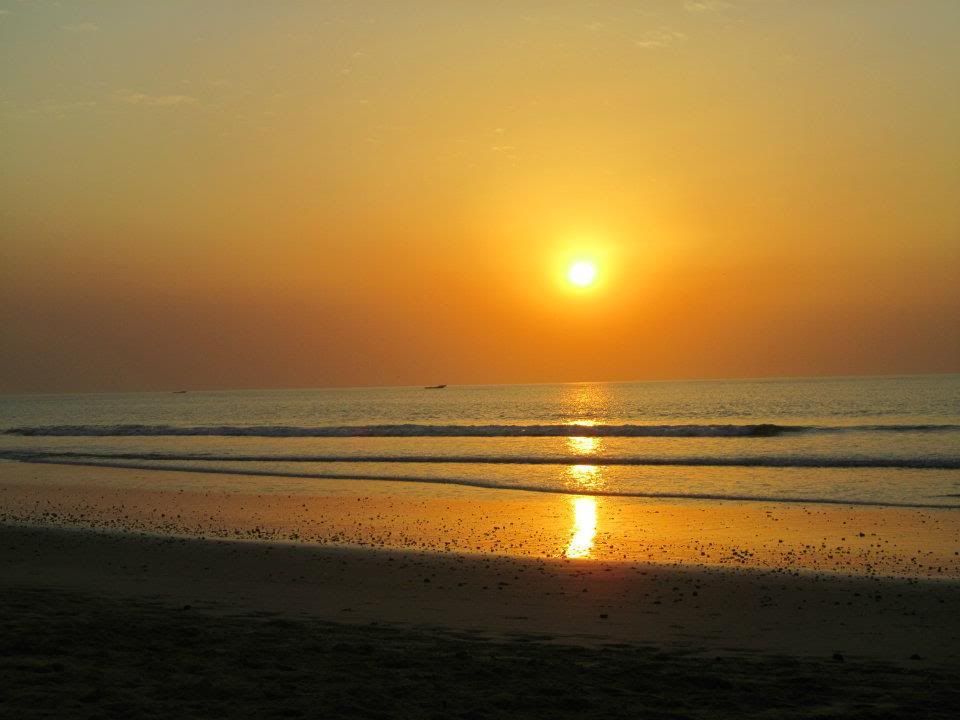
First, apologies and thanks to my dear family and friends in the states who have decided to continue reading my blog despite my most recent hiatus of about a month. Since classes have ended, I’ve gone on one trip after another without access to internet and sometimes electricity, and currently have my mom staying with me as a visitor for a couple weeks. Thus, I’ve been a bit preoccupied, and am completely overwhelmed at the prospect of covering all that has happened in the past few weeks. So, I’m going to start with my mother’s visit, and work my way backward from there. This might take a few entries... The picture above is a sunset on the gorgeous, peaceful beach situated on the doorstep of our favorite hotel, Boboi Lodge, in a small village, Kartong, located on the very southern coast of Gambia.
As I mentioned earlier, I was lucky enough to have my dear mother come and visit me here in Senegal for the holidays. She arrived a few days before Christmas, and will be leaving this Thursday night. She’s been staying with my wonderfully gracious host family and me, meals and all. The first day she arrived, my host mom, Ma, asked me what she should make for my mother’s first Senegalese lunch. I foolishly replied that it did not matter, whatever she made would be delicious. Her immediate reply was something along the lines of, “I know! I’ll make her suppakanja, that will be perfect!” In a previous entry, I explained suppakanja as “booger stew”, and Mom verified this comparison after the meal. Welcome to Senegal, Mom!
At mealtimes, Ma insists that Mom and I eat at the table in the living room from a platter separate from everyone else. It’s a bit awkward to be separated from the family at mealtime, but I know that Ma is simply trying to make Mom feel more comfortable and welcome as a guest. In the first two days of her arrival, Mom met dozens of members of my family, and struggled to remember names and piece together how everyone was connected. Everyone who meets my mother is thrilled, and greets her warmly. Usually, their first reaction is something along the lines of, “Really?! This is your mom? I thought it was just a girlfriend of yours! She looks so young!” While I agree that my mother has a young spirit and is a beautiful woman, this reaction is probably due to the fact that my mother is a very thin lady, and most Senegalese women her age are quite… plump. A very thin middle-aged woman is a bit of a foreign concept.
Two days after Mom arrived, it was Christmas. I woke up at 5am to go with Ellen to pick up her brother, Logan, and his friend, Patrick, from the airport who came to visit as well. We had to find two taxis to take them to their apartment across the street from my house in Karack, because Logan brought some extra luggage loaded with second-hand soccer equipment he brought from the states to give away in Dakar. It was my job to get Logan his taxi. This time, things did not go quite as smoothly. As usual, when we were leaving the airport, we were flocked by a group of 8-10 Senegalese men trying to get us to take their taxi. There was one man in particular who refused to leave us alone even though we were waiting by the gate for a taxi we had already arranged to come pick us up. He was very upset with us for not hiring his taxi. After we forced our way through the throng of men to our hired taximan (who was oh-so-helpfully leaning on the door waiting for us to push all the luggage the 50 meters to his car), loaded up the car, and got in, the same guy reached in the driver’s door for what looked like a reconciliatory handshake from the backseat. That was no reconciliatory handshake. If Logan hadn’t shut the door when he did, he might’ve actually pulled me over the passenger seat and out the door. That was the most aggressive interaction I’ve had so far here in Senegal. Actually, now that I think of it, probably the most aggressive interaction I’ve ever personally had. I suppose I should consider myself lucky that I haven’t experienced worse.
After the guys got settled in their apartment, we went directly to Christmas mass at the Keur Moussa monastery: take two. We didn’t take public transportation this time; instead the five of us piled into a Toyota Corolla taxi, with Mom sitting on my lap. The dusty drive to Keur Moussa took about an hour. When we finally arrived, the Gregorian chants were cool, but we were all struggling to keep our eyes open during the hour and a half long service. The highlights of the trip were the goat cheese, Senegalese jams, and fruity liqueurs produced by the monks that we purchased after the mass. The other highlight was on the ride back into Dakar, when Mom said she saw a naked man running along the side of the road “his organ bouncing around and everything!”, but sadly everyone else was asleep (except Patrick, who simply didn’t notice) and could not share in her exciting discovery.
It was a merry Christmas indeed.
After the first few days of immersion into Senegalese family life, Mom decided to splurge and stay at Hotel Sokhamon, which is about as “whimsical” as an entirely cement building can manage to be. In the same enormous lobby, there were African, modern, European, and Middle Eastern inspired pieces of art and furniture. The rooms themselves were lined along dark cave-like hallways, again made of molded cement. The hotel is located just next to the Corniche, right next to the ocean. The beachside of the hotel was covered in strings of Christmas lights and was equipped with an open-air bar that serves some Long Island Iced Teas that pack quite a punch, as Mom can attest to.
I can see my mom getting used to family life here. She no longer asks me for permission to take photos of family activities; she now uses her new French and sign language skills to ask my family members herself. She's even picked up a few Wolof greetings! Today, she managed to hand wash a few articles of clothing alongside Geneva, our newest maid, before Ma came upstairs and insisted that Mom shouldn’t be washing her own clothes despite my insisting that she wanted to learn, and was enjoying herself. I’m proud to see her exploring a new culture and learning two new languages (French and Wolof) despite all the challenges and frustrations that come with it. It’s also interesting to see her first reactions to the new sights, smells, and tastes, and reflect back on my own impressions of Dakar when I first arrived. So many of my perceptions have radically changed in a short period of time, like the concept of sanitary food preparation and what it means to have a balanced diet (the food groups are bread, rice, and meat, right?). My mother has but two small weeks to observe, process, and adapt to all of these cultural differences. And so far, she's done so with enthusiasm, grace, and patience.
I couldn't be more thrilled to be able to share my Dakar experience with someone as important to me as my mother. Thanks, Dad, for letting her miss Christmas at home so she could come visit me. Couldn't ask for a better Christmas present! Oh, and the giant bag of Reese's peanut butter cups she brought with her didn't hurt either :)
Friday, November 25, 2011
Lesson Learned
What sustains us, as humans? Work puts food on the table, work can challenge us to grow in different ways, but what makes us feel "whole"? I say, it's the people in my life at any given moment who I love, and who love me in return.
Anyone who thinks his wreckless work ethic that neglects his own health (mental or physical) is a product of his own talent is sadly delusioned. The only reason he might be able to operate self-destructively for long periods of time is that somebody is sustaining him through it. Somebody there to say, "Stop, breathe." Somebody to bitch to. Somebody who knows when you want a latte, or when you REALLY need a beer. Somebody to make you laugh at your own frustrations.
I've been doing a lot of reflecting on differences in lifestyle between Senegalese people, myself, and U.S. Americans as a whole (surprise, surprise). Since my arrival here in Senegal, I appreciate even more the people who support me on a daily basis. Family is the center of everything here, and everyone IS family. Whether you are friends since childhood or if five generations ago you had a relative who came from the same ethnic group as somebody else, they're considered family and they're a part of your support network. My host brother Momo once explained: if one person has a problem, it quickly becomes everyone's problem, and everyone comes together to offer their support. I see and respect that value of human support more and more as my time in Senegal continues, and I intend to continue to value those who support me on a daily basis, and do my best to offer the same support to those I care about.
Everyone needs relationships and human support, even if they live in the states, where everyone is supposed to be able to make it on their own.
Anyone who thinks his wreckless work ethic that neglects his own health (mental or physical) is a product of his own talent is sadly delusioned. The only reason he might be able to operate self-destructively for long periods of time is that somebody is sustaining him through it. Somebody there to say, "Stop, breathe." Somebody to bitch to. Somebody who knows when you want a latte, or when you REALLY need a beer. Somebody to make you laugh at your own frustrations.
I've been doing a lot of reflecting on differences in lifestyle between Senegalese people, myself, and U.S. Americans as a whole (surprise, surprise). Since my arrival here in Senegal, I appreciate even more the people who support me on a daily basis. Family is the center of everything here, and everyone IS family. Whether you are friends since childhood or if five generations ago you had a relative who came from the same ethnic group as somebody else, they're considered family and they're a part of your support network. My host brother Momo once explained: if one person has a problem, it quickly becomes everyone's problem, and everyone comes together to offer their support. I see and respect that value of human support more and more as my time in Senegal continues, and I intend to continue to value those who support me on a daily basis, and do my best to offer the same support to those I care about.
Everyone needs relationships and human support, even if they live in the states, where everyone is supposed to be able to make it on their own.
Thursday, November 10, 2011
La Fete des Moutons
Tabaski: a health inspector’s worst nightmare. The seven goats were kept on the terrace the few days before the party- so their poop and piss was everywhere. This morning, each goat was dragged down the stairs and slaughtered, then their tasty dead flesh was brought back up to the terrace, where it was “cleaned” and cooked. Don’t worry, they cleaned up the poop before they started cooking. Kind of. Well, it was pushed into the corners so it was mostly out of the way.
And the meat was cleaned before it was cooked. When I say clean, I mean we rinsed off the meat in a slightly soapy bucket of water. That’s right, yours truly (the would-be vegetarian) was right in the thick of it- cutting off the fat, rinsing the turds off, and other delightful activities. I only got grossed out once, when they peeled off a layer of skin and the fat just melted onto my hands.
I’ve never seen so much blatant cross-contamination while simultaneously eating such good food (in case you were wondering, grilled liver isn’t half bad). It wasn’t uncommon to see a woman cleaning the raw meat, dunk her hand in a bowl of water (no soap), then immediately begin eating a grilled rib with her bare hands. Also, remember the lingering poop chunks? They were quickly transported throughout the area by hitchhiking on the bottoms of shoes. I cringed every time one of the kids stepped over the plate we were eating from. Not to mention the time that a handful of onions fell on the floor, they were quickly rinsed with water and thrown back on the heap. No soap. Despite how much I enjoyed those mustardy spicy onions, I couldn’t eat any more after that.
I ventured downstairs twice. The first time, they were just beginning the slaughtering. I stayed just long enough to hear the choking of the goat and the gurgling of his blood after the cut his throat open, and to see another twitching as the last of his blood was dripping out. The second, I descended to find a neat pile of organs and a head where there used to be a goat. The smell was disgusting. After that, I definitely kept to the upstairs. It should be mentioned that almost no part of the goat goes to waste. Even the stomach and intestines are cleaned and saved to be cooked later in some couscous dish that I could wait a while before trying. And the heads are skinned and kept for making a certain kind of soup.
After all the meat was cleaned and distributed, lunch was served very late. In fact, the other students had already finished their meals, put on their traditional clothes, and came to visit my house before lunch was ready. So they were forced to eat a second enormous lunch, followed by homemade bissap and ditakh juice and fruit salad. After eating, I changed into my Tabaski clothes and went to go visit Ellen and Lauren’s families. This is the part of the holiday where everyone gets super dressed up in traditional clothes and visits the homes of all of their neighbors and ask forgiveness for any sins they may have done, and to offer forgiveness in return. Small children also visit other families, but for a slightly different reason- they ask for and are generally given small gifts of money.
Turns out that it’s also accepted to postpone this last part of the holiday. The rest of my family didn’t even bother to get dressed up in their Tabaski clothes after dinner because they were too tired. What’s so tiring about killing seven sheep, cleaning up the mess, and managing to cook a feast all in one day?
The rest of Tabaski was relaxed. There weren’t many people in the streets, and we spent the evening attempting to make Ataaya at Ellen’s house and watching Matilda on Lauren’s laptop. As Ellen’s mom told us, « Tous le monde fait ce qu’il veut à Tabaski. » Which translates roughly to, « Everyone does what they want on Tabaski. »
I walked away from the whole experience feeling well fed, proud that I was able to help out, and only mildly grossed out. However, I am definitely returning to vegetarianism when I return to the states with the flexibility to partake in forms of meat consumption that are local and humane in nature. I realized that, while I have no problem consuming meat after it has been transformed into a neatly cut, spiced, and cooked part of my meal; I do not have the stomach to even watch the act of taking an animal’s life, much less doing it myself. If I cannot manage to see this part of the meat production process, I can’t help but feel I have no business partaking in its end product (even if it is delicious).
Happy Tabaski, everyone! Excuse me for the wrongs I have done against you, and may we all live to enjoy another year together.
Sunday, November 6, 2011
Traditional Senegalese Dance
One of the last activities we did in Richard Toll was a village celebration at a Wolof village about 30 minutes away by car. We had no idea what we were getting ourselves into- when we arrived the drums were loud, and all of the children surrounded the car and greeted us as we got out of the car. When I say greet, I mean they were all screaming and laughing and shaking our hands, which sometimes got a little out of hand with the more aggressive kids who tried pulling our arms a little too hard, or who got a little too handsy.
Once we made it through the overwhelmingly friendly crowd, we were given seats in the large circle surrounding the drummers. It was obvious that our presence was the focus of attention- the drummers kept asking us to get up and youssa (the latest popular Senegalese dance) in the center of the circle, and other women would dance across the circle just to flay their peignes at our cameras.
Once we made it through the overwhelmingly friendly crowd, we were given seats in the large circle surrounding the drummers. It was obvious that our presence was the focus of attention- the drummers kept asking us to get up and youssa (the latest popular Senegalese dance) in the center of the circle, and other women would dance across the circle just to flay their peignes at our cameras.
The music was powerful and unrelenting, and the dancing was fervent. My jaw dropped at the intensity and passion with which the women moved their bodies. The spirit was infectious, we did end up getting pulled into the center of the circle and making fools of ourselves awkwardly bumbling around compared to the Senegalese. And it was awesome!!
Saint Louis Fish Market
Below is a short clip I took from the window of the van as we were driving in Saint Louis past the fish market next to the Senegal River. Not only does this give a sense of the quality of life here, but notice all of the bumps and jerks in the video. Its a result of the poor quality of the unpaved roads that are the norm in Senegalese cities.
Thursday, November 3, 2011
Langue de Barbarie
A national wildlife reserve best known for its diverse variety of migratory bird species called Langue de Barbarie we visited while in Saint Louis. Our guide told us we were visiting at a time of year when most birds were still up north; there will be far more varieties in a couple months. The landscape here is stunning (not that thats anything that stops locals from dumping trash on the beach), we saw beautiful white sandy beaches and clear water. The park was also FULL of crabs, especially near water. I couldn't believe how many there were! I took this next video standing on a small foot bridge-
Wednesday, November 2, 2011
Richard Toll: Part DEUX
In my last entry, I mainly focused on my family life in Richard Toll. Now, I'm going to try and explain what we were doing with our time when we were away from our families. As I mentioned before, the time spent in Richard Toll basically had the same daily schedule. Wake up 7:45, shower, eat breakfast, get picked up around 8:45, go wait (15 minutes to an hour) for our tour guide of the day to arrive at USAID, drive to the tour site, try and understand the French tours, return to our host families for a two hour lunch, get picked up again for either homework time or another tour, and return home by 7 to eat dinner around 8:30 and sleep by 10. Meanwhile, my stomach was fighting every step of the way- I reliably had diarrhea every other day. I don’t know why I had so many issues in Richard Toll compared to Dakar, but something was definitely not sitting right with my body.
The places we toured include a fish farm, water distribution facilities, farms (tomatoes, sugar, rice, manioc/cassava root, and corn), rice and sugar processing facilities, a dairy processing facility, a center for monitoring quality of seeds, Parc de Gueumbeul, Langue de Barbarie, a Peulh village, and a Wolof village celebration.
In general, I found the tours of farming facilities and factories to be less than thrilling. In general, each farmer/tour guide focused on techniques for increasing their productivity and some of the challenges they face in realizing maximum profits (think irrigation/planting techniques and detailed explanations of industrial processes and machinery). That was interesting to hear, but I was more interested in learning about how these farms and organizations played a role in the bigger picture of the socio-economic situation of the Senegal River Valley, like: What are the pros/cons of being a smaller scale farmer versus a large industrial cultivator? How are local economies affected by all of this industrial activity? What are the environmental costs? Who has access to these resources, and who doesn’t?
Eventually, I was able to satisfy some of my curiosity. Our final assignment was a 15 minute presentation (in French!) on a topic of our choice. I decided to take advantage of the assignment to do my own research on the implications of the two major dams on the Senegal River. The short 20 minutes a man took to quickly explain the purpose and creation of the dam was not sufficient for all the questions I had. I knew there had to be more to the story, and sure enough that’s what I found. There are tons of socio-economic, environmental, and health related consequences to the construction of the dams, and none of them are simple. Let’s take agriculture for example. Yes, the implementation of the dams has resulted in dramatic irrigated agricultural growth; however, this growth does not equally affect all local populations (like the Pulaar people, who depend on their grazing livestock, not farming). This farming has harmful effects as well, such as the pollution it produces in the same river where other people drink and bathe. Even something that sounds as simple as the creation of additional irrigated land for farming and increased economic productivity of a developing country is not entirely “good”.
I could go for a while on that rant, but in the interest of not boring you to death, I won’t.
Saint Louis
We spent two nights and three days at Saint Louis after the first five days in Richard Toll. Those might have been my favorite few days of the trip, because we had more variety in our daytime activities. We stayed at a place called Hotel Sindone, which was lovely and very French. The best part was definitely the food we ate there, we were each served a small basket of bread (including a croissant, a chunk of lemony bread, part of a baguette, and a chocolate pastry), a sweet crepe, fruit juice, REAL coffee, and a bowl of fruit. The first day, we arrived in Saint Louis, left our luggage in our hotel rooms, and walked into town to get lunch. I was delighted to find out we were having lunch at a middle-eastern restaurant, where I was happy with my hummous, vegetables, and labneh sandwich.
After that, we made a few stops around town, including the shop of an older, slightly eccentric artist. The old man was old and scrappy looking, and loved talking about the work he has done. At one point, he pulled out a huge piece of painted plywood with a copy of the Mona Lisa stapled in the middle and Wolof writing filling all the empty space. He told us of his almost decade long obsession with the Mona Lisa, and all of the research he has conducted in order to analyze the painting he finds so intriguing. He also showed us some smaller paintings featuring tidbits of Wolof wisdom. My personal favorite was a simple painting of a stick figure in a prostrate prayer position on what looks like a rug. The coordinating Wolof phrase translates to something like “Without clothes, prayer becomes scandalous.”
Africans are fun Muslims.
We returned to the hotel with just enough time to venture into town by foot again (this time without Prof Diallo) to look for a purse for Lauren and gifts for host families. Of course, we had to bargain for each purchase. I did pretty well, setting my price for some small bags made of beautiful African fabric at 500 CFA (1$) each. Not too shabby! Happy with our purchases, we returned for dinner at Hotel Sindone, which was another wonderful dining experience: perfectly seasoned carrot bisque followed by a main dish of a sautéed fish fillet and vegetables, and finished with a perfect portion of vanilla ice cream and raspberry sorbet (the combination became something along the lines of strawberry shortcake). The meal would’ve been good by US standards, but within the context of the meals our Senegalese families typically prepare (rice, meat, and heavy sauce), it was even more of a novelty.
The next day, we awoke to the same charming breakfast, left in the van to pick up a new guide, and visited Parc de Gueumbeul, a piece of land reserved to repopulate and observe African wildlife species that are endangered. In the front of the park were two large fenced-in areas to host the tortoises; one area for the babies, and one for those that were grown. I was surprised to see our tour guide walk right up to one of the gates, unhook the latch, and walk right in. We followed him, and stood right next to the huge tortoise as he talked about the animal (Lauren even sat on him!). He told us some interesting facts about tortoises: they hibernate for 6 months at a time, and can live up to 200 years. They are endangered because they are poached for their supposed aphrodisiac powers. Some Senegalese people eat their meat in the hopes of improving their sex lives, because the tortoises have long-lasting sex, or as our English-speaking guide so eloquently explained, “They make copulation for 3 hours of time.”
We continued our tour of the park on foot, and we saw a handful of singes rouges (red monkeys), a gazelle, some distant relative of the antelope with huge horns, and some ospreys (a predatory bird) along the way.
The rest of our stay in Saint Louis was a series of more delicious meals and various walks through the city. The biggest way we could see that Saint Louis is different than Dakar is the colonial construction of the buildings and that the streets of Saint Louis are MUCH cleaner than those of Dakar. We even saw our first trash can on the side of the road!
We returned to Richard Toll for the second half of our two week trip, and for the most part conducted more visits of agricultural facilities and were given time to create our final presentations which I mentioned earlier, that is until the weekend rolled around. The final experiences I had in Richard Toll were also the most interesting. And that, I am going to save for the next update.
Sorry for the delay in getting all this posted- it’s a lot to condense. I hope Mom will forgive me J
Grosses Bises,
Grosses Bises,
gk
Tuesday, October 25, 2011
Richard Toll: Part I
We left for Saint Louis on Tuesday afternoon right after lunch. All of my brothers dramatically claimed that my presence would be sorely missed, and that two weeks was far too long. One even instructed me to “become sick” after the first week so I would have to come back to Dakar. How sweet…?
Before the car ride, we decided to pay homage to our American roots the way any good ole patriot prepares for a road trip: we loaded up on candy and snacks, including suckers, my treat of choice. Of course we also shared with our professor, who claimed the four M&M’s he ate totally spoiled his appetite for dinner. Poppycock, I say. (You may be wondering where we found American candy like M&M’s… they were given to us by a lovely gentleman named David who was also studying at the Baobab Center to prepare for his new position within the military somewhere in Africa. He knew he would have left Dakar by the time we returned from St Louis, so he so generously showered us with parting gifts of American candy. I swear, no Snickers has ever tasted so good.) The drive was amazing: it was the first time we had technically left Dakar city limits. The countryside was flatflatflat the whole way, and the farther north we drove, the more desert-like it became. It was interesting to see clusters of huts and grazing sheep, goats, cows, and donkeys along the road. I am reminded of my love of travel. The open road and it's promise of new destinations calls to me more than a single city ever could.
The following few days had a similar schedule- in the morning we eat breakfast with our host families, are picked up to go on a tour of some aspect of agricultural production near Richard Toll (including tours of rice and sugar cane fields, irrigation systems for each, the water pumps for the surrounding communities), around 1:00 in the afternoon, we are dropped off at our host families for lunch, and then we are picked up again around 3:00 for more tours until we return again for the night around 7:00pm.
My host family’s last name is Sowdo Fall, and consists of an older retired couple. All the children have long since grown and moved out. I think it’s also a polygamous family, with the other wife living in another house, but I haven’t heard her mentioned at all yet. Also living here is a maid and the guard with his family (a wife and two adorable kids). Even though we don’t really have any language in common, they seem to all be gentle, kind, and patient. Sometimes I wonder if the children don’t work too hard: often my host mom will yell for them whenever she’s sitting in the living room and she doesn’t feel like walking to her room for her cell phone, locking the car, or answering the door. They also help with laundry, dishes, and bringing out food during mealtimes. The boy especially, who is probably about 12 years old, seems incredibly mature for his age, and always doing something helpful (like pulling water from the well or trying to bring out extra pillows to make me comfortable). I keep buying them little candies and gifts just because I want to see them be kids and SMILE.
Living with a host family in Richard Toll has been very different than living with my family in Dakar. I think part of the reason is that I am only here for two weeks (as opposed to six months), so I’m definitely more of a visitor, and less of a part of the family. That means it’s even less acceptable for me to do radical things like, oh, I don’t know, wash my own dishes or cut my own food or not eat a meal because I have diarrhea. My family in Richard Toll is far more insistent, even as I’m in the process of eating, they command “Lekkal, lekkal!” (“Eat, eat!” in Wolof) if I’m not doing so quickly enough. Madame Sowdo also gave me a pretty head scarf the other night, and has even cooked eggs for breakfast a few times. Her hospitality is wonderful.
Here are some other interesting differences:
Study Abroad "W" Curve Update:
I finally got my "Holy shit, I'm in Africa!" goosebumps that I think I've been waiting for since the day I've arrived in Dakar. I haven't been unhappy during my stay here, but it also hasn't quite felt real to me yet. I've been sightseeing and exploring and talking and learning and in general having a blast. But for some reason, I have still felt pretty neutral about the country of Senegal. It's been interesting to learn about, and the people have been warm and welcoming, but a large part of me has just been occupying time until I get to go back home to Michigan. Last night when my host mom showed me the breathtaking view of the night sky from the roof of her home, something in me just clicked. I was absolutely, completely content to be there on that roof in that moment and at the prospect of being in Senegal for the next 4 and a half months.
Wishing the same peace and contentment wherever and whoever you are,
gk
Before the car ride, we decided to pay homage to our American roots the way any good ole patriot prepares for a road trip: we loaded up on candy and snacks, including suckers, my treat of choice. Of course we also shared with our professor, who claimed the four M&M’s he ate totally spoiled his appetite for dinner. Poppycock, I say. (You may be wondering where we found American candy like M&M’s… they were given to us by a lovely gentleman named David who was also studying at the Baobab Center to prepare for his new position within the military somewhere in Africa. He knew he would have left Dakar by the time we returned from St Louis, so he so generously showered us with parting gifts of American candy. I swear, no Snickers has ever tasted so good.) The drive was amazing: it was the first time we had technically left Dakar city limits. The countryside was flatflatflat the whole way, and the farther north we drove, the more desert-like it became. It was interesting to see clusters of huts and grazing sheep, goats, cows, and donkeys along the road. I am reminded of my love of travel. The open road and it's promise of new destinations calls to me more than a single city ever could.
After the whole four hours it took to arrive in Saint Louis and then pick up two Senegalese students who would be accompanying us on our trip (they were two girls named Khadi and Fatou), we continued another hour before arriving in the smaller town we would actually be staying in. It’s called Richard Toll, and it’s somewhere between a village and a big city. Because we arrived so late that night, we spent the night at a hotel, eating dinner before going to bed. Mmmm, nothing like half a rotisserie chicken right before bed!
The following few days had a similar schedule- in the morning we eat breakfast with our host families, are picked up to go on a tour of some aspect of agricultural production near Richard Toll (including tours of rice and sugar cane fields, irrigation systems for each, the water pumps for the surrounding communities), around 1:00 in the afternoon, we are dropped off at our host families for lunch, and then we are picked up again around 3:00 for more tours until we return again for the night around 7:00pm.
My host family’s last name is Sowdo Fall, and consists of an older retired couple. All the children have long since grown and moved out. I think it’s also a polygamous family, with the other wife living in another house, but I haven’t heard her mentioned at all yet. Also living here is a maid and the guard with his family (a wife and two adorable kids). Even though we don’t really have any language in common, they seem to all be gentle, kind, and patient. Sometimes I wonder if the children don’t work too hard: often my host mom will yell for them whenever she’s sitting in the living room and she doesn’t feel like walking to her room for her cell phone, locking the car, or answering the door. They also help with laundry, dishes, and bringing out food during mealtimes. The boy especially, who is probably about 12 years old, seems incredibly mature for his age, and always doing something helpful (like pulling water from the well or trying to bring out extra pillows to make me comfortable). I keep buying them little candies and gifts just because I want to see them be kids and SMILE.
Living with a host family in Richard Toll has been very different than living with my family in Dakar. I think part of the reason is that I am only here for two weeks (as opposed to six months), so I’m definitely more of a visitor, and less of a part of the family. That means it’s even less acceptable for me to do radical things like, oh, I don’t know, wash my own dishes or cut my own food or not eat a meal because I have diarrhea. My family in Richard Toll is far more insistent, even as I’m in the process of eating, they command “Lekkal, lekkal!” (“Eat, eat!” in Wolof) if I’m not doing so quickly enough. Madame Sowdo also gave me a pretty head scarf the other night, and has even cooked eggs for breakfast a few times. Her hospitality is wonderful.
Here are some other interesting differences:
· Language: Aside from the older couple, everyone here speaks Pulaar, so my French is lost on them, and even the Wolof I’ve been learning only goes so far.
· Food: This family has strong Mauritanian roots, so many of the dishes I’ve been eating are more Mauritanian (which means more Arabic influence) than true Senegalese dishes. They also don’t use spoons to eat like my family in Dakar, so I’ve been learning how to eat with my hand, which has been interesting and harder than I expected. I’m always dropping rice on myself and have food on my face the majority of the time, so I’m kind of like the mealtime entertainment for anyone.
· Rural Life: There is a backyard here, that’s right- OPEN SPACE AND GREEN THINGS- including a Mango tree that everyone sits under during the day to hide from the sun. There is also a lot less pollution here- which means the night sky is absolutely gorgeous. Being more rural also means I’m a lot farther away from boutiques and other shops, so I’m a lot more dependent on my family for anything I might need.
· Electricity: There isn’t any. Not at my house, anyway.
· Personal Space: My room is half bedroom and half storage space for kitchen items. Often I wake up in the morning to my host mom or the maid rummaging through boxes on the other side of my room.
The moral of this story is that I’m pleasantly surprised to find myself getting to know and like my host family despite language barriers and the relatively short duration of my stay. I think I will be happy to return to my Dakar host family when the time comes- I miss having people my own age to spend time with and being able to talk with the people around me.Study Abroad "W" Curve Update:
I finally got my "Holy shit, I'm in Africa!" goosebumps that I think I've been waiting for since the day I've arrived in Dakar. I haven't been unhappy during my stay here, but it also hasn't quite felt real to me yet. I've been sightseeing and exploring and talking and learning and in general having a blast. But for some reason, I have still felt pretty neutral about the country of Senegal. It's been interesting to learn about, and the people have been warm and welcoming, but a large part of me has just been occupying time until I get to go back home to Michigan. Last night when my host mom showed me the breathtaking view of the night sky from the roof of her home, something in me just clicked. I was absolutely, completely content to be there on that roof in that moment and at the prospect of being in Senegal for the next 4 and a half months.
Wishing the same peace and contentment wherever and whoever you are,
gk
Monday, October 17, 2011
close but no keur moussa
Sunday morning our group woke up bright and early to go visit the monastery with the goat cheese and gregorion chants I mentioned last time. Cisco woke up to walk us to the place we needed to catch bus 71 headed out of town. The ticket there and back only cost about 1 dollar for each of us, and the bus ride took about an hour. When we arrived, we were confused to see that we were in a bustling town, not the isolated rural setting the travel books described. After asking a few locals where we could find the monastery, we were directed approximately 100m down the road, where a large church was located. The chirch looked more like a barn than anything else: a huge open space surrounded by cement walls, and birds flying in and out of the rafters. We quietly entered, took our seats in the back of the room, and waited for mass to start-
I just smashed an albino cockroach that scurried under our table with my flip flop. Ew.
So, yes, we attended a Catholic mass, and Ellen even took communion. After the end of the mass, we looked around for the renowned goat cheese, but didn't find anything. If this was a monastery, I had no idea where the monks lived, or why this would be a desirable destination for travellers. It was interesting to visit and see mass conducted with no hymnal books, and with "stained glass" windows that looked more like they were plain glass colored in with Crayola markers. The music they played was beautiful, lots of drums and the cora (a guitar-like instrument, except bigger and with many more strings), but we didn't hear any Gregorian chants- the singing was just like any other Catholic choir I've heard before.
Turns out there is another suburb of Dakar nowhere near the monastery that is called Keur Massar (the monastery is Keur Moussa), and that's where we ended up.
What happened is I asked my host brothers where I could catch the bus to Keur Moussa, but they insisted that I meant to say Keur Massar. And because I didn't know any better, I assumed that I had read the guide book wrong. I mean, how many Keur M..ss.. places are there near Dakar? Lesson learned- never assume something is self-evident when it comes to travelling.
All in all, it was a pretty cheap lesson that only took up one Sunday morning, and was still something worth seeing. (Did I mention on the bus ride back, we saw a group of people stuffing a live sheep into the trunk of a taxi to transport it?) Don't worry, we're not giving up, and are going to try again when we return from Saint Louis.
I just smashed an albino cockroach that scurried under our table with my flip flop. Ew.
So, yes, we attended a Catholic mass, and Ellen even took communion. After the end of the mass, we looked around for the renowned goat cheese, but didn't find anything. If this was a monastery, I had no idea where the monks lived, or why this would be a desirable destination for travellers. It was interesting to visit and see mass conducted with no hymnal books, and with "stained glass" windows that looked more like they were plain glass colored in with Crayola markers. The music they played was beautiful, lots of drums and the cora (a guitar-like instrument, except bigger and with many more strings), but we didn't hear any Gregorian chants- the singing was just like any other Catholic choir I've heard before.
Turns out there is another suburb of Dakar nowhere near the monastery that is called Keur Massar (the monastery is Keur Moussa), and that's where we ended up.
What happened is I asked my host brothers where I could catch the bus to Keur Moussa, but they insisted that I meant to say Keur Massar. And because I didn't know any better, I assumed that I had read the guide book wrong. I mean, how many Keur M..ss.. places are there near Dakar? Lesson learned- never assume something is self-evident when it comes to travelling.
All in all, it was a pretty cheap lesson that only took up one Sunday morning, and was still something worth seeing. (Did I mention on the bus ride back, we saw a group of people stuffing a live sheep into the trunk of a taxi to transport it?) Don't worry, we're not giving up, and are going to try again when we return from Saint Louis.
Friday, October 14, 2011
An apple a day keeps the constipation away.
I've reached an important milestone. I had my first normal poop today. Alhamdulilaay! My strategy? Lots of apples and fiber supplements. I guess rice is a pretty strong "stopper".
Other than that, this week has been relatively uneventful, "relatively" being the operative word. Ellen, Lauren, and I have done more navigating of the city on our own, without Senegalese guides this week. We've bargained hard for some good taxi prices, we've had our first taxi break down mid-ride (don't worry, we arrived at our destination safely because our driver hailed another taxi for us, and didn't charge us anything), and I almost got hit by a bus. There isn't even a real story with that last one, just a classic case of Grace-not-looking-where-she's-going.
Academically, I feel like this week might be the calm before the storm. We had three classes cancelled and haven't had any significant homework due. Next Tuesday, however, we leave with one of our professors to go north to Saint Louis (an old colonial city, and the first capital of Senegal) for two weeks. We will each be staying with a different host family during our time there and touring various agricultural and production facilities along the Senegal River.
Upon our return to Dakar, we have two days before our "ICRP Prospectus" is due: 3 pages written in French detailing the aspect of Senegalese culture we would like to observe/investigate for our ICRP. ICRP stands for Inter-Cultural Research Project, and it will be what I will be spending my last two months in Dakar working on. It could take almost any form, but the key elements in my experience must include learning something that will benefit me later in life, closely experiencing an aspect of Senegalese culture, and then comparing it to the States. Also, three other courses have smaller similar assignments as final projects we have to begin working on soon. All include finding a location to make observations and conducting research on the topic.
I feel overwhelmed by all of the projects. There is by no means a lack of interesting subjects I can study, but at this point in the process, there are so many unknowns swirling around in my head and the amount of work seems enormous. More on the direction of these projects later---
I'm really looking forward to this weekend. On Sunday, we will take a short day trip to attend mass at a monastery just outside of Dakar. The monastery is famous for its Gregorian chants (think Monty Python, Dad) and goat cheese they produce to earn their living. This peculiar combination sounds very appealing to me, but I am also looking forward to a quiet Sunday morning, and a chance to relax and gather my thoughts.
Until next,
gk
Other than that, this week has been relatively uneventful, "relatively" being the operative word. Ellen, Lauren, and I have done more navigating of the city on our own, without Senegalese guides this week. We've bargained hard for some good taxi prices, we've had our first taxi break down mid-ride (don't worry, we arrived at our destination safely because our driver hailed another taxi for us, and didn't charge us anything), and I almost got hit by a bus. There isn't even a real story with that last one, just a classic case of Grace-not-looking-where-she's-going.
Academically, I feel like this week might be the calm before the storm. We had three classes cancelled and haven't had any significant homework due. Next Tuesday, however, we leave with one of our professors to go north to Saint Louis (an old colonial city, and the first capital of Senegal) for two weeks. We will each be staying with a different host family during our time there and touring various agricultural and production facilities along the Senegal River.
Upon our return to Dakar, we have two days before our "ICRP Prospectus" is due: 3 pages written in French detailing the aspect of Senegalese culture we would like to observe/investigate for our ICRP. ICRP stands for Inter-Cultural Research Project, and it will be what I will be spending my last two months in Dakar working on. It could take almost any form, but the key elements in my experience must include learning something that will benefit me later in life, closely experiencing an aspect of Senegalese culture, and then comparing it to the States. Also, three other courses have smaller similar assignments as final projects we have to begin working on soon. All include finding a location to make observations and conducting research on the topic.
I feel overwhelmed by all of the projects. There is by no means a lack of interesting subjects I can study, but at this point in the process, there are so many unknowns swirling around in my head and the amount of work seems enormous. More on the direction of these projects later---
I'm really looking forward to this weekend. On Sunday, we will take a short day trip to attend mass at a monastery just outside of Dakar. The monastery is famous for its Gregorian chants (think Monty Python, Dad) and goat cheese they produce to earn their living. This peculiar combination sounds very appealing to me, but I am also looking forward to a quiet Sunday morning, and a chance to relax and gather my thoughts.
Until next,
gk
Sunday, October 9, 2011
l'Ile de Madeline
Check out my pictures from this weekend- instead of writing another entry, I wrote descriptions on the pictures that tell some stories.
Enjoy!
Enjoy!
The day I was too pissed to wear pants.
You know how some days you're in such an awful mood with nothing to blame other than waking up on the wrong side of the bed? This was one of those days. I was just pissed to have been disturbed from my uncommonly restful sleep. Then, I realized my sheets were soaked with my own sweat. Fine, I thought, I'll just take a nice, refreshing shower to cool off. One of my brothers must have been taking a shower at the same time, because the water came out of the shower-head in a depressing trickle. I think the added heat of being in the tiny, enclosed, humid space of the bathroom made me sweat even more than the water could wash away. I dried off, got dressed, put on sunscreen and was ready to meet my buds to go to the island for the day. Then I touched my face and realized that none of the sunscreen had actually been absorbed into my skin. I was sweating so much, I actually felt like my face was melting. Disgusted, I ripped off all my clothes and flopped on my bed in only my swimsuit- already overwhelmed with the day even though it was only 9am.
I decided the only possible way I could survive the rest of the day would be if I wore shorts. I KNOW that its disrespectful as a woman to show my thighs- but I also KNEW that I was at my wit's absolute end for whatever reason. So I took my leaky face, scandalous shorts, dorky keens, and I bravely marched them downstairs to say goodbye to the host family. I got strange looks from everyone, and one of the older women pointed at the approximate thigh region on my body and commented, "C'est jolie comme ca! (It is pretty like that)" I have no idea if she meant my pasty, hairy legs, or if she meant my worn-out running shorts. Both seemed equally unlikely, so I just point at myself and said emphatically, "RIEN est jolie ici. (NOTHING is pretty here.)" To which the entire room busted up laughing.
Look out Dakar, I got thunder thighs, and I'm NOT afraid to bare them!
I decided the only possible way I could survive the rest of the day would be if I wore shorts. I KNOW that its disrespectful as a woman to show my thighs- but I also KNEW that I was at my wit's absolute end for whatever reason. So I took my leaky face, scandalous shorts, dorky keens, and I bravely marched them downstairs to say goodbye to the host family. I got strange looks from everyone, and one of the older women pointed at the approximate thigh region on my body and commented, "C'est jolie comme ca! (It is pretty like that)" I have no idea if she meant my pasty, hairy legs, or if she meant my worn-out running shorts. Both seemed equally unlikely, so I just point at myself and said emphatically, "RIEN est jolie ici. (NOTHING is pretty here.)" To which the entire room busted up laughing.
Look out Dakar, I got thunder thighs, and I'm NOT afraid to bare them!
Monday, October 3, 2011
a quiet weekend
This weekend was very boring. Lauren, Ellen, and I decided it would be a lazy one so we could catch up on some much needed sleep. Saturday we woke up with plans to go to the beach, but I got sick- I slept the whole day, emerging from my room only to show my face at mealtimes. I couldn't eat no matter how much my brothers insisted "You MUST eat to get better!" I have a sneaking suspicion they meant to say "You MUST eat if you want to vom!" I can tell I'm truly adapting, because they're beginning to irritate my like a true brother might. And I say that affectionately.
Sunday morning I woke up feeling recharged and refreshed from a day off and went on a short run along the Corniche (the road that runs along the ocean) with Lauren and Ellen. I don't know if I have talked about this phenomenon yet, but I'm too lazy to re-read previous entries. Sorry if I'm repeating:
Working out here is rather bizarre. Many women "run", but what they really mean is that they "power walk", and many of these women are Muslim and wear scarves around their head, long pants, and sleeves to maintain their modesty. I have no idea how they aren't all passed out on the side of the road like dead flies: I can hardly breathe in my t-shirt and shorts! Also, men and women alike workout in the kinds of clothes my high school cross coach would cringe to see. Flip flops are common, and so are polo shirts or other clothes us Americans would never consider as athletic wear.
We finished our walk back with three nice, refreshing coconuts--- er, Ellen and Lauren thought so anyway. The coconuts are sold by men who push dingy carts piled with them. When you buy one, the man first takes his large knife and chops away and creates a small hole on the top of the coconut, where you put the straw to drink the coconut milk. The liquid is surprisingly clear for the heavy, milky, bitter taste it has. After you drink the liquid, the vendor chops the coconut in half and you eat the true "coconut insides". For me, the coconut was neither appetizing nor refreshing. I was quite disappointed, but also glad that we didn't pay any money to buy them. A nice older runner paid for them for us because we ABSOLUTELY needed to have one for each of us.
Later Sunday, I received some difficult news from home that made me realize how totally helpless I am to my friends and family while I am in Africa. I wanted nothing more than to jump on the next plane home- but given the impossibility of that sentiment, I cried to Mom and Dad, adding to their already great stress. It's not possible to really help from this position, but I realized I'm certainly able to harm. I'm grateful to my parents for finding the patience to tolerte my outrageous phone call nonetheless.
Monday morning was a vast improvement. With the light of day, things didn't seem so bad, and I even received a text from Dad relieving some of my concerns. Plus it helped that the power (thus, the fan) stayed on for the first entire night!
Now I'm sick again, and was told (along with Lauren, who unfortunately shares my symptoms) by two different professors that "You must be happy and energetic in my class, you must not be sick!" Apparently professors are super perceptive with only three students in a class. I think that the worst possible thing to say to this sick person is exactly that. I feel like shit, I've been listening to French for 8 hours, and no, I'm not going to smile!!
Even though my head is filled with snot and nausea, today was the first time I came home and felt a sense of relief. Today, it wasn't a daunting task to make little conversations with each person and struggle to find something to talk about. Sitting on the terrace with my brothers, I was happy to ramble about my sister who I'm so proud of (and worried about!) and pass pictures around. I also had a surprisingly neutral conversation about polygamy. After I expressed my views on the subject, he just said, "Wow". I thought he was offended by my liberal and strong opinions since it is common for Senegalese men to have more than one wife, but he elaborated, "Just then, you spoke very well. That was really great french!"
Totally made my evening. Now I can attempt to stomach dinner, take some good 'ole nyquil, and SLEEP happy.
Sunday morning I woke up feeling recharged and refreshed from a day off and went on a short run along the Corniche (the road that runs along the ocean) with Lauren and Ellen. I don't know if I have talked about this phenomenon yet, but I'm too lazy to re-read previous entries. Sorry if I'm repeating:
Working out here is rather bizarre. Many women "run", but what they really mean is that they "power walk", and many of these women are Muslim and wear scarves around their head, long pants, and sleeves to maintain their modesty. I have no idea how they aren't all passed out on the side of the road like dead flies: I can hardly breathe in my t-shirt and shorts! Also, men and women alike workout in the kinds of clothes my high school cross coach would cringe to see. Flip flops are common, and so are polo shirts or other clothes us Americans would never consider as athletic wear.
We finished our walk back with three nice, refreshing coconuts--- er, Ellen and Lauren thought so anyway. The coconuts are sold by men who push dingy carts piled with them. When you buy one, the man first takes his large knife and chops away and creates a small hole on the top of the coconut, where you put the straw to drink the coconut milk. The liquid is surprisingly clear for the heavy, milky, bitter taste it has. After you drink the liquid, the vendor chops the coconut in half and you eat the true "coconut insides". For me, the coconut was neither appetizing nor refreshing. I was quite disappointed, but also glad that we didn't pay any money to buy them. A nice older runner paid for them for us because we ABSOLUTELY needed to have one for each of us.
Later Sunday, I received some difficult news from home that made me realize how totally helpless I am to my friends and family while I am in Africa. I wanted nothing more than to jump on the next plane home- but given the impossibility of that sentiment, I cried to Mom and Dad, adding to their already great stress. It's not possible to really help from this position, but I realized I'm certainly able to harm. I'm grateful to my parents for finding the patience to tolerte my outrageous phone call nonetheless.
Monday morning was a vast improvement. With the light of day, things didn't seem so bad, and I even received a text from Dad relieving some of my concerns. Plus it helped that the power (thus, the fan) stayed on for the first entire night!
Now I'm sick again, and was told (along with Lauren, who unfortunately shares my symptoms) by two different professors that "You must be happy and energetic in my class, you must not be sick!" Apparently professors are super perceptive with only three students in a class. I think that the worst possible thing to say to this sick person is exactly that. I feel like shit, I've been listening to French for 8 hours, and no, I'm not going to smile!!
Even though my head is filled with snot and nausea, today was the first time I came home and felt a sense of relief. Today, it wasn't a daunting task to make little conversations with each person and struggle to find something to talk about. Sitting on the terrace with my brothers, I was happy to ramble about my sister who I'm so proud of (and worried about!) and pass pictures around. I also had a surprisingly neutral conversation about polygamy. After I expressed my views on the subject, he just said, "Wow". I thought he was offended by my liberal and strong opinions since it is common for Senegalese men to have more than one wife, but he elaborated, "Just then, you spoke very well. That was really great french!"
Totally made my evening. Now I can attempt to stomach dinner, take some good 'ole nyquil, and SLEEP happy.
Subscribe to:
Posts (Atom)